
Health is not an afterthought. It is the basis.
Listen to the Ruimte zat podcast with Michel van Schaik and Bart Meijer below.
Ten years of a healthy living environment at the heart of Utrecht: from ambition to system change
A healthy society does not arise in the hospital, but in the neighbourhood. In the street. At school. At work. That message was central to the 'Healthy Development' session at PROVADA, where Michel van Schaik, Director of Healthcare at Rabobank and co-author of Diagnosis 2040, talked to Bart Meijer, CEO of MRP and co-developer of Cartesius in Utrecht, and Carolien Schippers, group director of Healthy Urban Living of the Municipality of Utrecht. The conversation was moderated by Alex Sievers of Beyond Now and one of the founders of the Blue Zone Festival.
Earlier, Bart Meijer and Michel van Schaik spoke about Happiness and Health in the podcast, organized by PROVADA in collaboration with Elba REC.
Ten years ago, Utrecht was one of the first cities in the Netherlands to opt for a fundamentally different course: healthy urbanisation as the basis for broad prosperity. Not health as a closing item of policy, but as a starting point for how a city grows, develops and invests. With attention to exercise, mental well-being, equality of opportunity, education, work, meeting and a sustainable living environment. Now, ten years later, it is becoming clear what that choice yields.
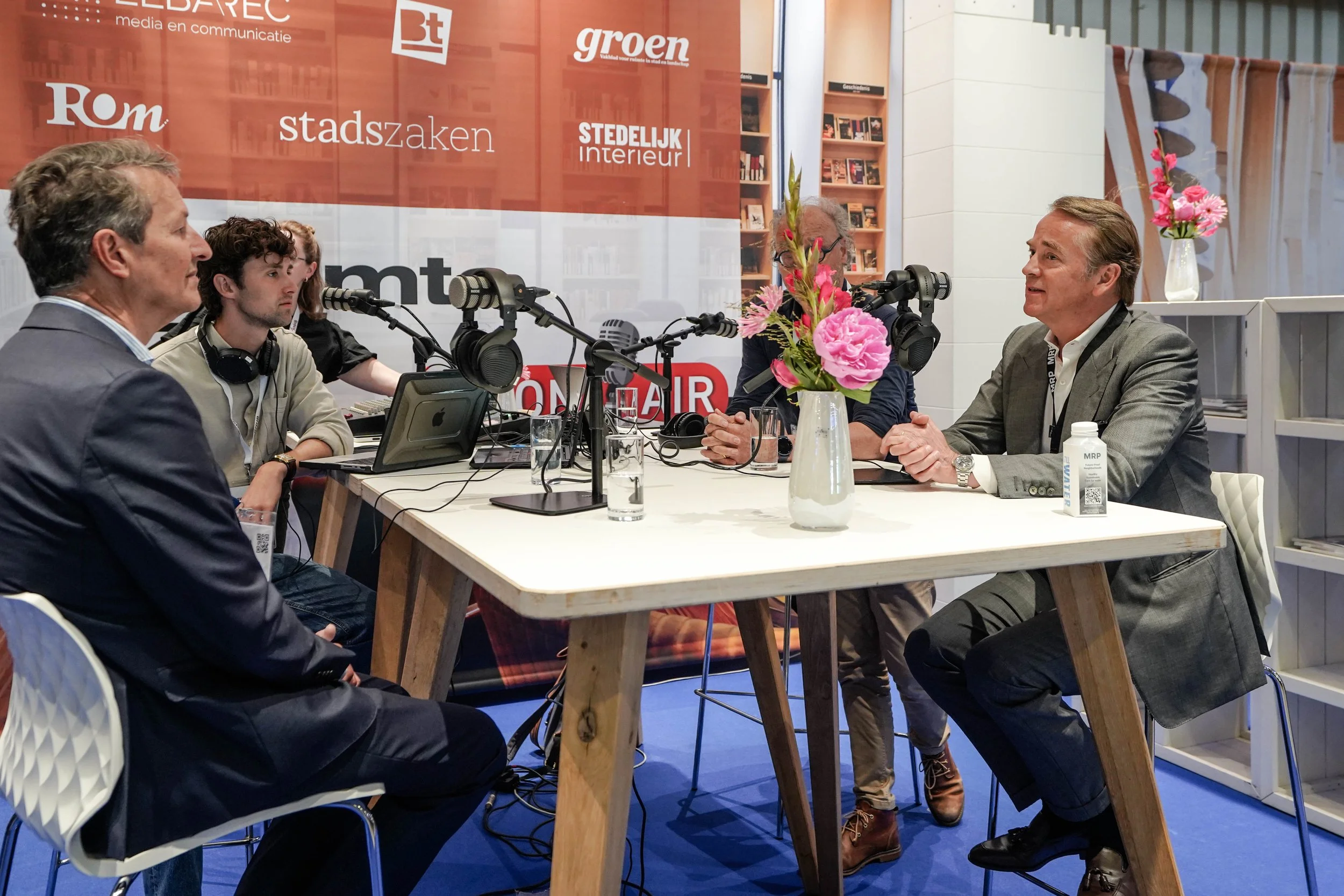
In the picture from left to right: Michel van Schaik (Director of Healthcare at Rabobank) and Bart Meijer (MRP)
Photo credits: Pascale van Reijn, Van Reijn Creative Studio.
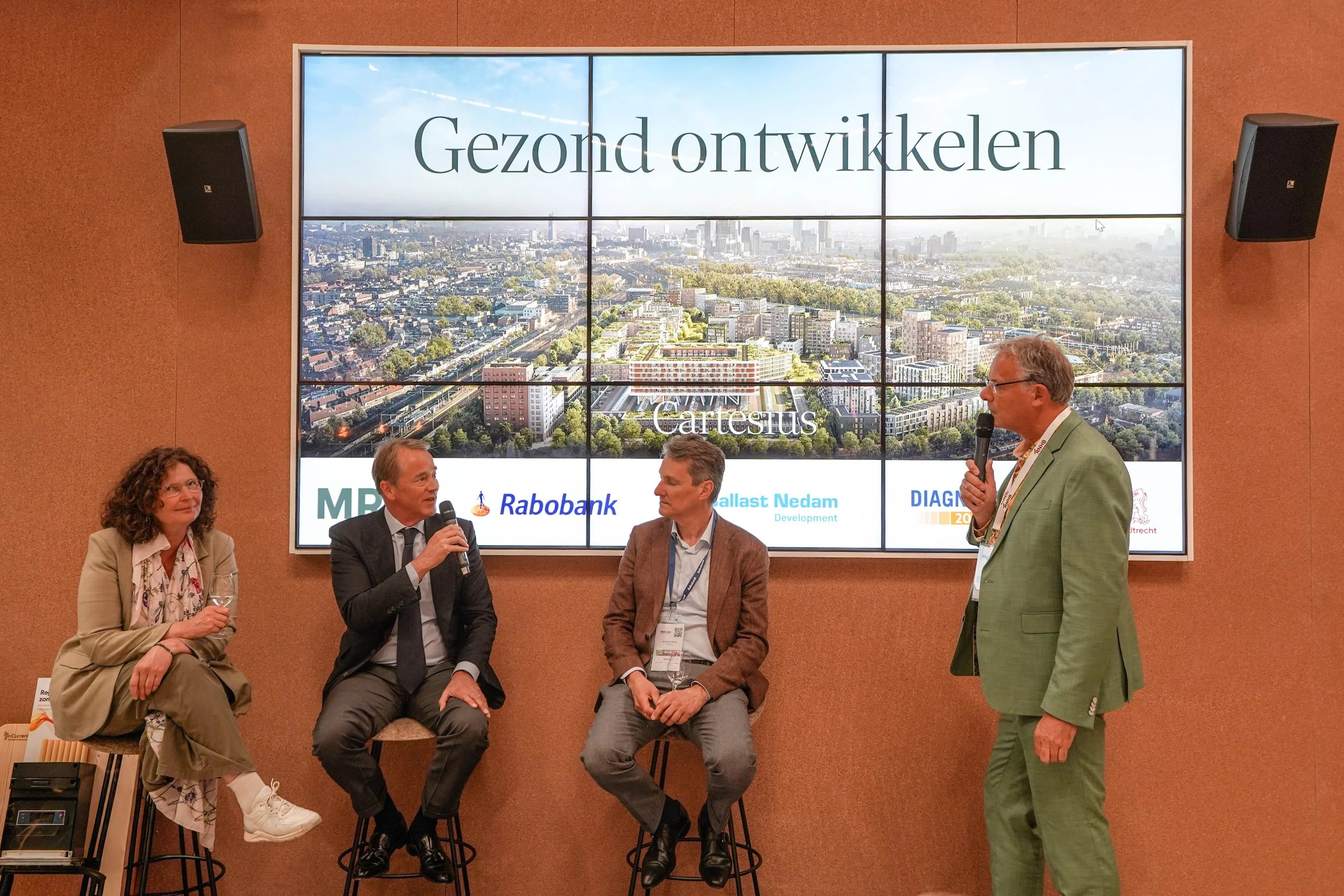
From left to right: Carolien Schippers, Bart Meijer, Michel van Schaik, and Alex Sievers at Rabobank PROVADA 2026.
Cartesius as a living testing ground for the future
In Cartesius Utrecht, the Utrecht vision takes concrete shape. Since the start of the area development in 2018, developers, knowledge institutions, governments and the business community have been working together on a new standard for urban living. Not with separate initiatives, but from one common starting point: structurally embedding health in how we design and inhabit neighbourhoods.
Cartesius shows that a healthy living environment is more than extra greenery or a footpath. It is about an integrated approach in which living, working, meeting, exercise and well-being reinforce each other. An approach that is supported by data, followed over time and made measurable in social impact.
From local experiment to national movement
According to Michel van Schaik, the Netherlands is on the eve of a fundamental system change. In Diagnosis 2040 , health is no longer seen as a subject of the healthcare sector alone, but as a guiding principle for policy, investments and area development.
"A healthy living environment does not arise by itself. To achieve this, public and private parties must work together differently. Not next to each other, but with a shared responsibility for the health of people and vital communities."
This movement is directly in line with the experiences in Utrecht. Whereas the city started ten years ago with an ambitious vision, there is now a growing awareness that health not only creates social value, but also adds economic value and strengthens the resilience of cities.
Bart Meijer explained how developers have an increasing responsibility to include health in area development from the first design phase. The Cartesius Development Consortium is working on an urban district in which space for meeting, exercise, nature and sustainability are an integral part of the plan.
Carolien Schippers underlined the importance of cooperation between government, developers, investors and civil society organisations. With its policy for a healthy living environment for everyone, the Municipality of Utrecht is emphatically committed to creating neighbourhoods where residents can grow up, live, work and grow old in a healthy way.
Health as a new social transition
Rabobank will therefore make health one of its central social themes from 2026 onwards, alongside sustainability, energy and food transition. The conviction is clear: a healthy society starts with people who feel good physically, mentally and socially. This requires a different way of thinking, investing and developing. Breakthrough coalitions that connect sectors and put health at the heart of all choices made about the future of our living environment.
The question is not whether this change will come
The session made it clear that the movement towards a healthy living environment is no longer a niche for forerunners. The first results are visible, the social urgency is growing and the economic arguments are getting stronger.
The question is no longer whether this breakthrough will come. The question is: who moves along?
Read more here:
Cartesius catalyst for a healthy and economically strong society, https://www.cartesius-utrecht.nl/nieuws/cartesius-katalysator-voor-een-gezonde-en-economisch-sterke-samenleving,
Diagnosis 2040 – fundamental transformation, https://www.diagnoseprogrammas.nl/diagnose-2040/
Bricks don't make a neighborhood - https://onderzoek-cartesius.nl/wp-content/uploads/sites/1193/2026/05/Stenen-maken-nog-geen-buurt-versie-2.pdf